

Scaling Compliant Output for a Regulated Gambling Affiliate
We helped a regulated gambling affiliate scale weekly publishing with structured workflows, specialist review, and compliance-aware content that held up in a high-trust market.


Regulated iGaming affiliate content at scale
If you work in iGaming, you’ve probably seen a dozen agencies make the same promises. They make big claims, repeat the same talking points, and say very little about why clients hired them in the first place.
We prefer to show how the work holds up inside real partnerships and let the results speak for themselves. In regulated gambling, that often means protecting client privacy. Not every operator, affiliate, or content team wants their internal process, vendor relationships, or performance strategy discussed publicly, even when the work has gone well.
That is what this case study series is about. We are sharing how HIREQUARTERS supports iGaming brands through real engagements, while keeping the source anonymous where discretion matters.
For this case study, we spoke with a senior editorial stakeholder at an established brand in the casino and sports betting affiliate space. Their perspective offers a close look at what content teams in this industry need from an outside partner, where the pressure points tend to show up, and what strong support looks like in practice.
Below, we’ll break down why they brought HIREQUARTERS in, what problems they were trying to solve, and how the partnership helped improve content delivery, internal workflow, and long-term organic performance.
What’s the Biggest Problem You Were Trying to Solve Before Working With HIREQUARTERS?
When asked what needed fixing before HIREQUARTERS came in, the answer was immediate: production numbers were not where they needed to be. Weekly publishing output was trailing competing sites, and that gap was starting to matter.
On the surface, that sounds like a page-count issue. In practice, it usually runs deeper than that. In casino and sports betting affiliate search, publishing pace affects how quickly a site can expand topical coverage, build authority across key terms, and stay active in spaces where competitors are pushing fresh content live every week.
For an established affiliate brand, the challenge was not simply to publish more for the sake of volume. The goal was to raise output without losing editorial quality, drifting off intent, or creating problems on the compliance side. That is where many teams get stuck. Raising volume is easy once standards start slipping. Scaling content in a regulated niche without breaking the process is harder.
That is where HIREQUARTERS came in. The task was not just more pages. The real job was to increase output while still meeting the editorial bar, supporting SEO goals, and serving as a content partner the internal team could rely on.
Why Was Content Creation a Critical Part of Solving That Problem?
The answer was pretty direct: they did not need more content for the sake of volume. They needed content worth publishing on a regular basis. In this space, it is easy to crank out 20 weak pages a week. That was never the goal. The goal was to build a dependable flow of high-quality content that could move through the pipeline and go live without becoming extra cleanup work for the internal team.
That gets to the heart of the production problem. The issue was not a shortage of drafts. The issue was a shortage of publishable drafts. In casino and sports betting affiliate searches, low-value pages do little besides slow the process down. They eat up editorial time, create bottlenecks, and rarely give the site the kind of coverage or search traction the team is trying to build.
Content creation mattered because it sat so close to growth. Better output meant more opportunities to cover valuable terms, expand topical depth, and stay active in search while competitors kept publishing. None of that helps, though, if the material coming in is too thin, too rough, or too far off the mark for editors to trust.
That is why content creation became such a central part of the fix. The job was not just to raise production. It was to create a process that could consistently deliver strong pages, without piling more pressure on the internal editorial team. HIREQUARTERS helped build a more dependable publishing engine, not just a bigger stack of drafts.
What Regulatory or Compliance Constraints Shaped Your Content Strategy?
When asked which constraints shaped the content strategy most, the client pointed to two areas. One was the need to stay within US sweepstakes boundaries, especially around legal states and market availability. The other was an internal editorial standard built around honesty, including criticism where criticism was earned.
A large part of the work came down to getting the legal footing right. Sweepstakes content in the US can get messy once state-by-state access enters the picture, so broad assumptions were not going to work. The research needed to be careful, because a weak read on legal states or market access can quickly create problems.
The editorial side carried just as much weight. The client was not looking for soft praise or generic approval. The expectation was that the content would call out weak offers, poor user experience, or product flaws when warranted. Maintaining that level of candor becomes harder as production speeds up.
HIREQUARTERS had to work within both sets of expectations at once. The content needed to stay factually grounded and sensitive to sweepstakes constraints, while still preserving the more candid editorial style the client wanted. That balance is not easy to maintain once gambling content gets more nuanced.
What Attracted You to HIREQUARTERS as a Solution for That Problem?
The client answered pretty plainly. The initial draw was affordability.
That is not unusual. Any team trying to scale content has to look at cost, especially when the problem involves output, production pressure, and the need to publish more without overstretching internal resources. The real question is what comes with the price.
Low-cost content is easy to find. Content that is affordable and still usable at an editorial level is harder to find. For this client, price may have opened the conversation, but it would not have kept the relationship going on its own.
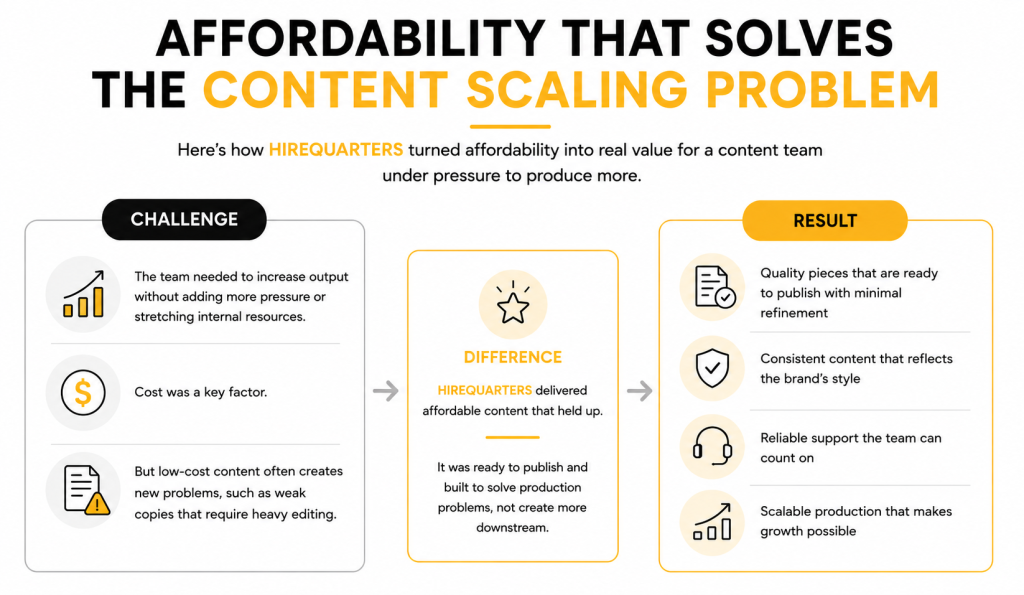
HIREQUARTERS became more than a budget option because the work still needed to hold up once it reached the internal team. The content had to be publishable, consistent, and strong enough to help solve the production problem rather than create a new editing problem downstream.
That is where affordability started to mean something more practical. It was not just lower cost on paper. It was a pricing level that made scaling possible without forcing the team to settle for weak drafts or unreliable support.
What Made You Choose HIREQUARTERS for Specialist iGaming Content Creation?
When asked what made HIREQUARTERS stand out for specialist iGaming content, the client pointed to the trial piece. Their view was simple: after the initial test, they were impressed by how well HIREQUARTERS picked up not only the written instructions, but also the brand’s own style. Very little refinement was needed before the piece was ready.

That answer says a lot about what the team was really looking for. The need was not just for writers who could follow a brief. The need was for a partner who could pick up brand voice, understand editorial expectations, and deliver copy that did not need a major rewrite before publication. In specialist iGaming content, that is a meaningful separator. Plenty of agencies can cover the basics of SEO. Fewer can turn in copy that already sounds like it belongs on the site.
The answer also addresses one of the biggest concerns about outsourced content: editorial drag. If every draft comes in needing heavy cleanup, outside support does not solve much. It just moves the workload further down the chain.
HIREQUARTERS earned trust early because the test piece demonstrated strong reads on style, expectations, and execution. That made the partnership easier to believe in from the start and gave the internal team more confidence in what would come next.
How Did HIREQUARTERS Approach Content Strategy Differently?
When asked what felt different about HIREQUARTERS’s approach to content strategy, the client did not point to some grand process or fancy framework. The answer was more practical. The content came in well-researched, questions were asked when the source material or data were unclear, and the copy fit the brand’s natural style.
That gets close to what editors usually care about most. Strong content is not just a matter of covering the topic. It needs solid research behind it, enough judgment to stop and question fuzzy inputs, and a voice that sounds right once the page goes live.
HIREQUARTERS brought that into the workflow from the start. Instead of rushing from brief to draft, the work involved checking unclear points, reviewing source material carefully, and shaping the copy to match the brand’s editorial style. That made the content easier to handle the moment it landed with the internal team.
From an editorial standpoint, that changes a lot. There is less cleanup, less back-and-forth, and less time spent fixing copy that should have arrived in better shape. The strategy felt different because the work came in with more care behind it, which made the entire production process easier to run.
What Type of Content Was Created and Why?
When asked what kind of content HIREQUARTERS was creating, the client pointed to a mix of informational pages and reviews, including work around sweepstakes casinos, slots, and, more recently, prediction markets.
Each content type served a different purpose. Informational pages helped cover topics readers were still trying to understand. They gave the site room to explain newer or less familiar areas, answer foundational questions, and meet users earlier in the search journey before brand comparison became the main focus.
The review side served a different kind of search. A user looking for a sweepstakes casino review or a prediction market review is usually farther along and wants a more specific read on the product. Those pages needed sharper evaluation, more product detail, and a clearer sense of where the offer or platform stood when examined more closely.
For the client, the value came from having both working together. Informational content helped broaden coverage and support authority across emerging topics. Review content served users who were closer to making a decision. Together, the mix gave the site a wider reach without losing its commercial direction.
How Did Content Quality and Expertise Show Up in Practice?
When the client described quality, the answer went straight to a point every editor recognizes. The drafts usually arrived in strong enough shape to move forward with little to no refinement, which meant pages could be published faster without burning extra time on rewrites.
That says quite a bit on its own. The content was not coming in as a rough draft that needed to be rebuilt section by section. It arrived with enough structure, clarity, and polish to move through the process without the usual editorial drag.
Expertise showed up in the parts that tend to create the most work when they are missing. The research was already there. The copy was well organized. The writing held together. Instead of spending hours patching weak sections or reworking the page’s logic, the internal team could focus on getting strong content live.
For a busy editorial operation, that kind of reliability matters. It keeps production moving, reduces cleanup work, and makes outside support feel like real support instead of another layer to manage.
What Measurable Outcomes Did You See?
The clearest measurable outcome showed up in publishing pace. As the client put it, weekly output rose by 150 percent, moving from four published pages per week to 10.
A jump like that changes the range of what a site can cover. More pages going live each week means more opportunities to target useful search terms, strengthen priority sections, and stay active in areas where competing brands are publishing at a steady clip.
For a content-led business, higher output expands the site’s footprint in a very direct way. It gives the team more room to build coverage, support growth areas, and keep important categories from going stale.
In this case, the increase mattered because the pages were getting published in a form the team could use. Output moved up, the site saw more content entering the market, and the editorial process remained workable as that pace increased.
Did Working With HIREQUARTERS Change Your Long-Term Content or Growth Strategy?
The client’s answer suggests the partnership changed more than weekly output. Once HIREQUARTERS was handling a larger share of content creation, the internal team had more room to work on older pages, strengthen key sections of the site, and put more attention into high-priority pillar content.
That kind of shift matters because growth work often gets pushed aside when a team is stuck chasing day-to-day publishing needs. If all available time goes into keeping new pages moving, older assets tend to sit untouched, even when they still carry value or need improvement.
With outside support taking pressure off production, the team had more flexibility in how it used its time. New pages were still going live, but internal resources were no longer tied up in the same way. That opened up space for work with a longer shelf life, including optimization, structural improvements, and stronger pillar-page development.
For a content-driven brand, that kind of change can have a meaningful effect on the wider strategy. The team is no longer forced to choose between maintaining publishing pace and improving the parts of the site that matter most over time.
Who Would You Recommend This Approach to?
When asked who this kind of support made sense for, the client gave a pretty clear answer. It fits teams that want to keep publishing at a sustainable pace without compromising on quality.
That points to a specific kind of brand. The best fit is usually a company trying to grow output while keeping editorial standards in place. In gambling and other regulated spaces, publishing more only helps if the work coming in is dependable enough to move through review without dragging the process down.
It also tends to encourage teams to think beyond next week’s content queue. Brands investing in authority, organic growth, and a stronger long-term content base usually get the most from this kind of setup. The value lies in having a pace the team can maintain and a standard the site can keep building on.
It is less likely to fit companies chasing the lowest possible price or trying to flood the site with volume while keeping editorial control to a minimum. Those are different goals, and they usually call for very different kinds of content operations.
What Advice Would You Give to Other Operators Investing in Content Today?
When asked for advice, the client kept it simple. Pick quality over quantity. In their view, one strong page will do more over time than a handful of weak ones pushed out too quickly.
That is especially true in gambling content. It is easy to fill a publishing calendar with rushed pages, but most of them do not help much once they go live. They add clutter, take up editorial time, and rarely earn much in search.
A stronger page has a better shot. Good research, clear writing, and useful information give it more staying power. It is more likely to attract traffic, retain its value, and give the site something worth building on.
For operators investing in content now, the takeaway is pretty clear. Publishing more only helps when the work is good enough to justify the page. Once volume starts outrunning quality, the site can fill up with content that looks productive on paper but does very little once it is live.
Key Takeaways
The client needed higher output without compromising editorial standards.
Strong research and a close match to the brand voice helped the content move through editing with less friction.
The weekly publishing pace increased from 4 pages to 10.
The internal team had more room to work on pillar pages and older content with longer-term SEO value.
HIREQUARTERS proved especially useful for a brand looking to scale content without lowering standards.
Want Similar Results?
HIREQUARTERS helps iGaming brands grow with content built for search, shaped for compliance, and ready to support long-term performance.

Get in touch to see what a stronger content operation could look like for your brand.